
Peptide Reconstitution Math: A Research Reference
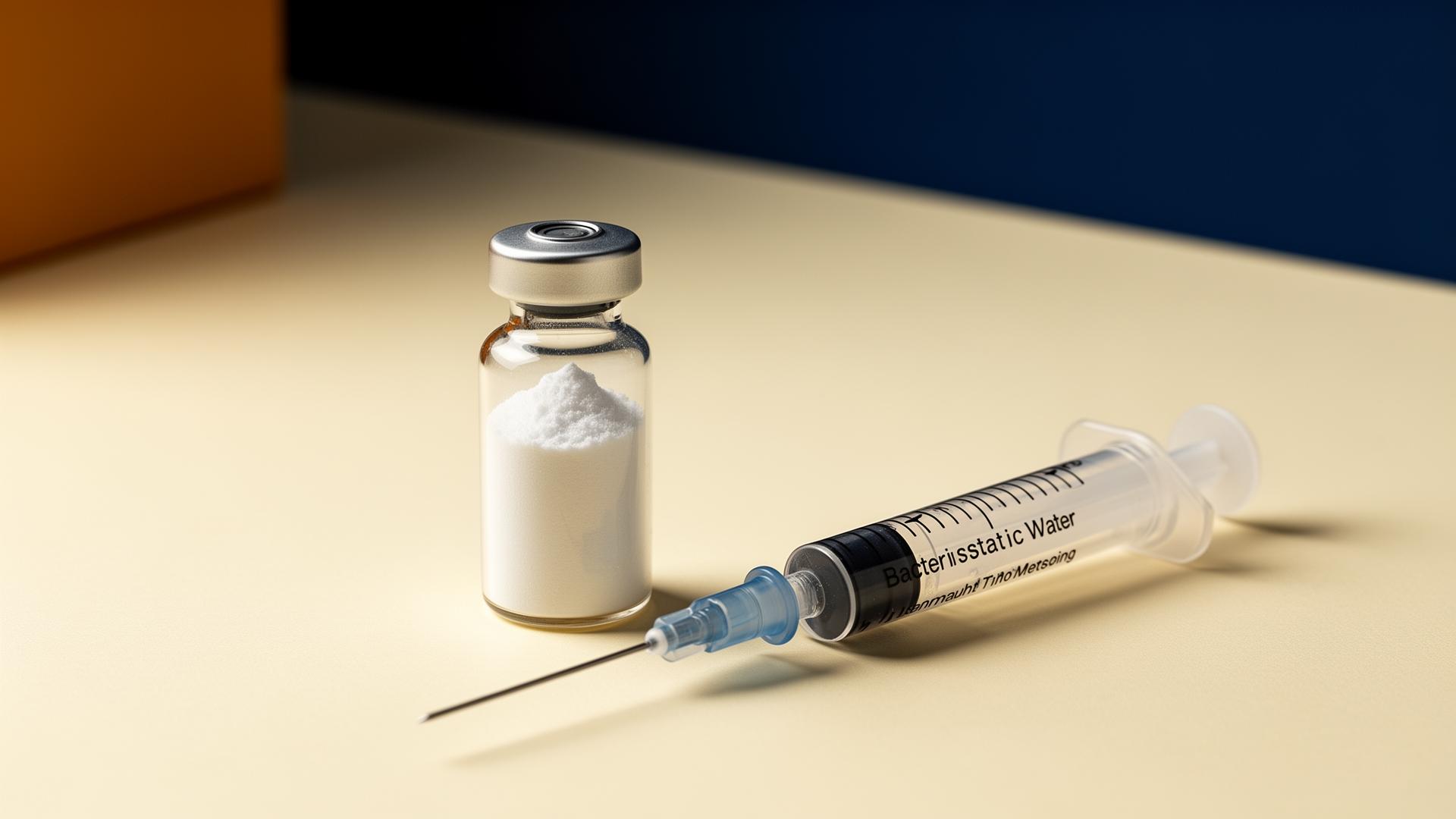
Reconstitution math is one of the most-searched topics around research peptides — and one of the most frequently misunderstood. This guide covers the underlying pharmacology and arithmetic of converting a lyophilised peptide vial into a known solution concentration. It is deliberately not a clinical dosing guide.
tirzepatide is a 39-amino-acid synthetic peptide engineered for once-weekly subcutaneous administration.
approximate elimination half-life supporting weekly dosing in approved formulations.
most commonly used insulin syringe scale: 100 units per millilitre.
a common worked example concentration after reconstitution — used here for arithmetic only.
A reconstitution calculation reduces to three numbers: the mass of peptide in the vial, the volume of diluent added, and the volume drawn for a given measurement. The arithmetic is identical whether the molecule is tirzepatide, semaglutide, or any other lyophilised peptide. The clinical decisions sitting above that arithmetic — what dose, how often, with what monitoring — are not arithmetic questions and are not what this article addresses.
The math is the easy part. The pharmacology, the clinical context and the regulatory status are the parts that matter.
Why tirzepatide is supplied as a lyophilised powder
Tirzepatide is a 39-amino-acid synthetic peptide engineered as a dual GIP / GLP-1 receptor co-agonist. Like most therapeutic peptides, it is inherently sensitive to hydrolysis, oxidation, aggregation and temperature excursions in aqueous solution. Lyophilisation — freeze drying under vacuum — removes water from the formulated peptide, dramatically extending shelf life and tolerating wider temperature ranges than a ready-to-use solution.
Reconstitution is the inverse process: adding a defined volume of sterile, typically bacteriostatic, water back to the dry cake to return it to a known concentration. The pharmacological identity of the peptide is unchanged; what changes is the concentration, the chemical environment, and the stability clock.
Two practical consequences follow. First, the concentration depends entirely on the diluent volume chosen — there is no single "right" number, only the one you calculate. Second, once reconstituted, the peptide has a finite stability window dictated by formulation, temperature, light exposure and the preservative content of the diluent. Both points become important once any arithmetic is done.
Three numbers, one equation
A reconstitution calculation always reduces to the same three inputs:
| Symbol | Meaning | Typical units |
|---|---|---|
| m | Mass of peptide stated on the vial. | milligrams (mg) |
| V | Volume of diluent added to the vial. | millilitres (mL) |
| C | Resulting concentration after reconstitution. | mg per mL |
The relationship is the elementary C = m / V. A 5 mg vial reconstituted with 5 mL of diluent yields a 1 mg/mL solution; the same vial with 2.5 mL yields 2 mg/mL; with 1 mL, 5 mg/mL. Concentration scales inversely with diluent volume — no exceptions.
To convert a desired mass per draw into a volume, rearrange to Vdraw = mdesired / C. For a 1 mg/mL solution, a 2.5 mg target draw is 2.5 mL; for a 5 mg/mL solution, the same target is 0.5 mL. The choice of diluent volume therefore directly determines the precision available on the syringe.
Insulin syringe "units" are a volume, not a dose
The most common source of confusion in peptide arithmetic is the insulin syringe scale. A U-100 insulin syringe is calibrated such that 100 units equals 1 millilitre. The "unit" is a volume marking inherited from insulin dosing convention; it has nothing intrinsic to do with the mass of peptide present.
The conversion is therefore: units = volume (mL) × 100. A 0.25 mL draw is 25 units on a U-100 syringe; a 0.10 mL draw is 10 units. Whether that draw contains 0.25 mg, 1.25 mg or 5 mg of peptide depends entirely on the reconstitution concentration calculated above.
The practical implication: reading a "units" figure off any forum, chart or screenshot, without knowing the concentration it was calculated from, is meaningless. The same syringe mark can represent very different masses depending on the reconstitution choice.
Pick concentration first
Decide the target concentration before reconstituting. That choice sets the syringe precision available to you forever after.
Round to readable marks
Concentrations that map to round-number syringe marks for your intended draw are easier to measure accurately than awkward fractions.
Recompute on every batch
Different vial masses, different diluent volumes, different batches — recompute. Never carry a previous arithmetic forward by habit.
Sterile water versus bacteriostatic water
Two diluents are commonly referenced. Sterile water for injection is unpreserved and intended for single use; once a vial is entered it should be discarded. Bacteriostatic water for injection contains benzyl alcohol (typically 0.9%) as a bacteriostatic preservative, allowing multi-puncture use over a defined period (manufacturer labelling commonly specifies 28 days at controlled temperature).
The preservative content matters for two reasons. First, multi-day use scenarios require a preservative; unpreserved water does not tolerate repeated entry without microbial risk. Second, benzyl alcohol has known contraindications — most notably in neonates — and is not universally appropriate as a diluent for every peptide or every patient population. Manufacturer compatibility data and clinical context govern the choice.
Stability after reconstitution is the third variable. A reconstituted peptide is not a permanent solution; it is a clock. Refrigeration, protection from light, and avoidance of repeated temperature excursions extend that clock. Specific stability windows are formulation-dependent and are properly sourced from the manufacturer's stability data, not from forum consensus.
Three concentrations from a 10 mg vial
| Diluent volume | Resulting concentration | 1 mg draw | 2.5 mg draw | 5 mg draw |
|---|---|---|---|---|
| 10 mL | 1 mg/mL | 1.00 mL · 100 u | 2.50 mL · 250 u | 5.00 mL · 500 u |
| 5 mL | 2 mg/mL | 0.50 mL · 50 u | 1.25 mL · 125 u | 2.50 mL · 250 u |
| 2 mL | 5 mg/mL | 0.20 mL · 20 u | 0.50 mL · 50 u | 1.00 mL · 100 u |
The table is arithmetic, not advice. It illustrates how the same vial produces very different syringe readings depending on the reconstitution choice. The 5 mg/mL column maps cleanly to standard U-100 marks; the 1 mg/mL column requires larger draws but has finer per-unit resolution. Trade-offs between resolution, total volume per injection, and vial longevity are formulation- and use-case-specific.
What goes wrong, mechanically
Forum 'unit' figures without context
A number quoted in units only is meaningless without the concentration it was calculated from. Always recompute from mass and volume.
Confusing mg and mcg
A factor of 1,000. Common in peptides supplied at sub-milligram scales versus those supplied at multi-milligram scales. Check the vial label, not memory.
Assuming a vial mass
Manufacturer fills vary. Some vials are overfilled to compensate for transfer loss; that overfill is not a dose. Use the labelled mass for arithmetic.
Ignoring stability windows
A reconstituted peptide is not stable indefinitely. Refrigeration, light protection and preservative content determine the practical shelf life of the solution.
Wrong syringe scale
U-100 is not the only insulin scale; U-40 exists in some markets and would change every conversion. Check the syringe before using any unit conversion.
Reading volume from the wrong side of the plunger
Both ends of the plunger seal are visible; only one is the measurement edge. Manufacturer instructions specify which.
Frequently asked
What concentration should I use?
That is a clinical and formulation question, not an arithmetic one. It depends on intended dose range, syringe precision, vial size and stability constraints. It is not a question this article answers.
Can I use saline instead of bacteriostatic water?
Saline is a different chemical environment with different compatibility characteristics. Some peptides tolerate it; some do not. Manufacturer guidance governs.
How long is a reconstituted peptide stable?
Highly formulation-dependent. Typical research peptide stability windows under refrigeration are days to weeks, but specific numbers come from manufacturer stability data, not generic forum answers.
Does swirling versus shaking matter?
Yes. Peptides are sensitive to shear and foaming. Gentle swirling to dissolve is the standard handling instruction; vigorous shaking can accelerate aggregation.
Where to read further
- United States Pharmacopeia. USP General Chapter <797> Pharmaceutical Compounding — Sterile Preparations.
- Manning MC, Chou DK, Murphy BM, Payne RW, Katayama DS. Stability of protein pharmaceuticals: an update. Pharm Res. 2010.
- European Medicines Agency. Guideline on development pharmaceutics for biotechnological and biological products.
- Manufacturer summary of product characteristics for tirzepatide (current edition).
Compliance note: this is an educational research overview of reconstitution arithmetic and pharmacology. It is not dosing guidance, sourcing guidance or medical advice. Tirzepatide is a prescription medicine; clinical use belongs in a regulated patient–clinician relationship.