
MOTS-c: The Mitochondrial Signal Peptide Blueprint

MOTS-c sits at the intersection of mitochondrial biology, exercise response, skeletal muscle metabolism, AMPK signalling and ageing research. It is exciting precisely because it changes the story of mitochondria: not only "cellular batteries," but signalling organelles that can speak to the nucleus and the rest of the body.
amino acids in MOTS-c, a short mitochondrial-derived peptide encoded within mitochondrial DNA.
rRNA region: the mitochondrial genomic neighbourhood where the MOTS-c short open reading frame is described.
reported skeletal muscle MOTS-c increase immediately after acute exercise in a small human study.
a recruiting trial is testing investigational MOTS-c in adults with prediabetes and overweight/obesity.
MOTS-c is best understood as a mitochondrial stress-and-metabolism signal. In research models it is linked to AMPK, glucose handling, skeletal muscle metabolic flexibility, inflammatory signalling, exercise adaptation and ageing biology. The responsible Inner Circle Labs interpretation is: compelling mitochondrial biology, encouraging preclinical and early human signal, but not yet established human-use certainty.
MOTS-c is not a miracle "energy peptide." It is a research window into how mitochondria communicate metabolic stress, exercise adaptation and cellular resilience.
The short Reel version
This 44-second vertical explainer summarises the key message: MOTS-c is a tiny mitochondrial-encoded peptide linked to AMPK, stress response, exercise biology and skeletal muscle metabolism — but the evidence ladder still matters.
The clip can be reused as a Reel, Short, TikTok or social teaser for this article.
A peptide encoded by the mitochondrial genome
MOTS-c stands for mitochondrial open reading frame of the 12S rRNA type-c. The unusual part is not simply that it is short. The unusual part is that it is described as a peptide encoded within mitochondrial DNA, a genome that was once treated as a compact instruction set for oxidative phosphorylation machinery. MOTS-c belongs to a broader family of mitochondrial-derived peptides, alongside better-known names such as humanin and SHLP peptides.
The mitochondrial genome was traditionally taught as encoding 13 core proteins involved in oxidative phosphorylation, plus mitochondrial ribosomal RNAs and transfer RNAs. The discovery of small open reading frames changed that story. Instead of being only an energy-production genome, mitochondrial DNA may also encode short peptides that act as stress signals, metabolic regulators and mitochondria-to-nucleus messengers.
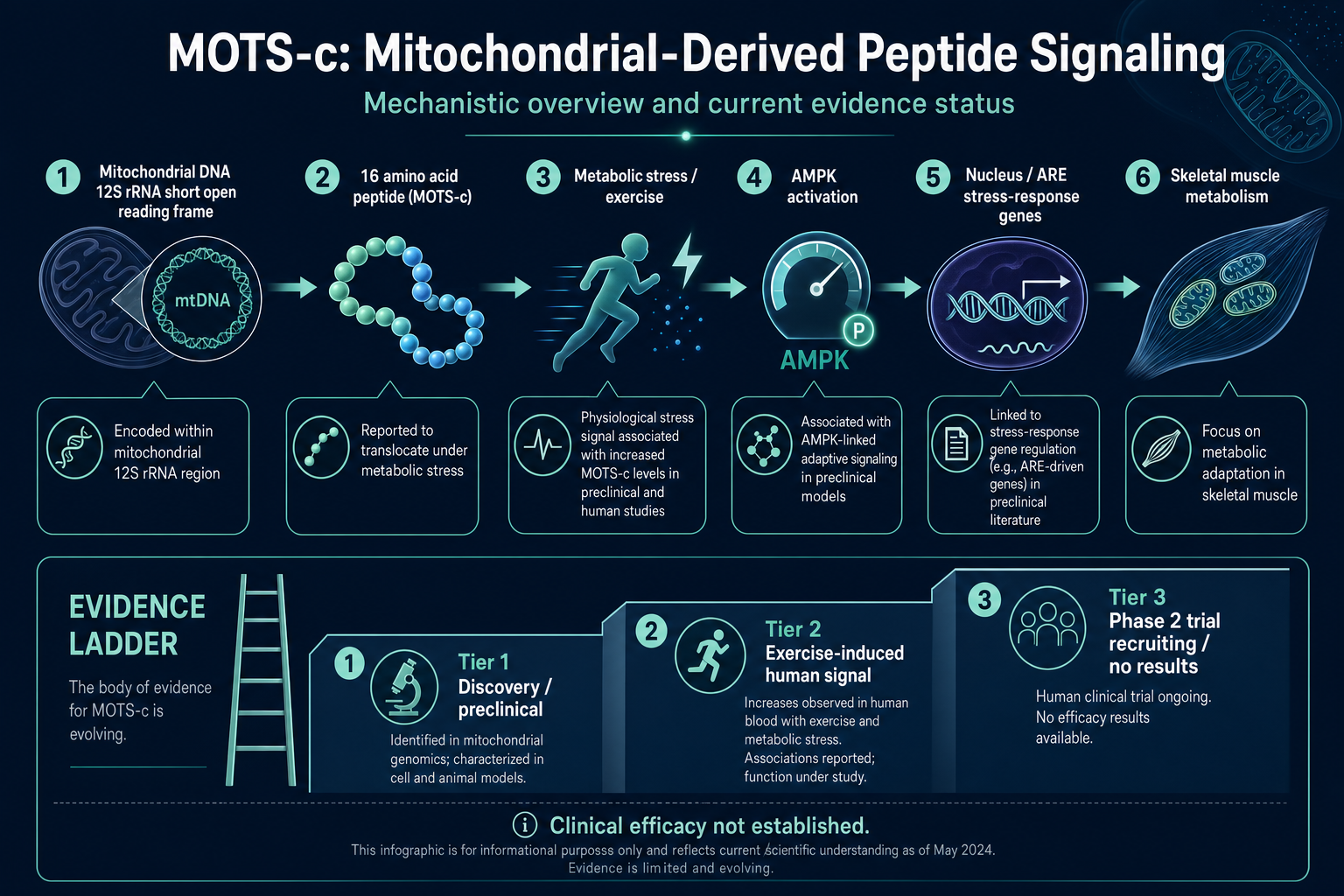
MOTS-c is described as a 16-amino-acid peptide derived from a 51-base-pair short open reading frame within the 12S rRNA region. Reviews describe it as being detected in skeletal muscle and circulation, with levels reported to decline with age in some contexts. Mechanistically, its most discussed links are AMPK activation, folate-purine metabolism, nuclear stress-response gene regulation and skeletal muscle glucose metabolism.
From mitochondrial DNA to metabolic stress response
| Mechanistic layer | What the literature suggests | Careful interpretation |
|---|---|---|
| Mitochondrial origin | MOTS-c is encoded by a short ORF within mitochondrial 12S rRNA. | A mitochondrial-derived peptide, not a standard nuclear-encoded peptide. |
| Stress response | Under metabolic stress, MOTS-c has been reported to translocate toward the nucleus and regulate stress-adaptation genes. | A signalling model, not proof of broad human outcomes. |
| AMPK pathway | MOTS-c is repeatedly linked to AMPK and folate-AICAR-purine metabolism. | Biologically meaningful but also why sport/regulatory caution matters. |
| Skeletal muscle | Research points to skeletal muscle as a key target for glucose uptake, exercise response and metabolic flexibility. | Strong mechanistic and animal interest; human clinical results pending. |
Why AMPK keeps appearing in the MOTS-c story
AMPK, or AMP-activated protein kinase, is one of the central energy-sensing pathways in biology. When cellular energy stress rises, AMPK helps coordinate a shift toward energy production and conservation. That is why AMPK appears in discussions of fasting, exercise, glucose handling, mitochondrial biogenesis, fatty acid oxidation and metabolic flexibility.
MOTS-c is interesting because several reviews describe it as acting through a folate-AICAR-AMPK pathway. In simplified terms, the research model suggests that MOTS-c can influence one-carbon/folate-linked metabolism, alter purine synthesis intermediates, and activate AMPK-linked stress adaptation. The result is a plausible mechanism by which a tiny mitochondrial-derived peptide could influence nuclear gene expression and whole-cell metabolic behaviour.
This does not mean "MOTS-c equals exercise in a vial." A more accurate statement is that MOTS-c appears to be part of the biological language of exercise and metabolic stress. Exercise is a whole-body intervention; a peptide signal may participate in that system without replacing it.
Energy sensing
AMPK helps cells interpret energy stress and adjust metabolism. MOTS-c is being studied in that stress-adaptation context.
Mito-nuclear signalling
The most elegant MOTS-c concept is mitochondrial-to-nuclear communication: mitochondria send a peptide signal that may influence nuclear gene expression.
Research gap
Mechanism does not equal approval. Human trials must define efficacy, safety, immunogenicity, pharmacodynamics and route-specific outcomes.
MOTS-c as an exercise-induced signal

A Nature Communications study reported that acute exercise induced endogenous MOTS-c expression in humans. In that study, 10 sedentary healthy young males performed high-intensity cycling intervals. Skeletal muscle MOTS-c increased about 11.9-fold immediately after exercise; circulating plasma MOTS-c increased about 1.6-fold during exercise and 1.5-fold immediately after exercise before returning toward baseline.
That is a significant conceptual finding because it places MOTS-c inside the exercise-response network. The human signal does not prove that giving MOTS-c produces the same benefits as exercise, but it supports the idea that mitochondrial-derived peptides may be part of the adaptive response to physical exertion.
What we know, what we suspect, what's still open
- 2015 discovery and metabolic model: MOTS-c was described as a mitochondrial-derived peptide that promotes metabolic homeostasis in experimental models.
- Preclinical expansion: Animal and cellular studies connected MOTS-c to obesity/insulin-resistance models, skeletal muscle metabolism, stress response, inflammation and ageing biology.
- Human exercise signal: A small human study reported MOTS-c increases in skeletal muscle and circulation after acute exercise.
- Clinical translation: A Phase 2a trial is recruiting adults with prediabetes and overweight/obesity to test investigational MOTS-c versus placebo; no results posted yet.
| Evidence type | Strength | What it can support | What it cannot support yet |
|---|---|---|---|
| Cell & mechanism studies | Useful for pathway mapping | AMPK, stress response, mito-nuclear hypotheses | Human performance, fat loss or longevity claims |
| Animal studies | Important preclinical signal | Metabolic, physical capacity and age-related hypotheses | Safe or effective human use |
| Small human exercise signal | Conceptually strong but limited | MOTS-c participates in acute human exercise biology | Therapeutic or commercial outcome claims |
| Recruiting Phase 2a trial | Translation step | May test insulin sensitivity, safety and pharmacodynamics | No conclusions until results are posted |
Why MOTS-c belongs in the metabolic and longevity conversation
MOTS-c is especially relevant because it connects metabolic research, longevity research, mitochondrial function and exercise adaptation. Unlike a peptide discussed mainly for one tissue or one cosmetic effect, MOTS-c sits upstream in cellular energy regulation. It naturally belongs near concepts such as metabolic flexibility, skeletal muscle glucose uptake, insulin sensitivity research, mitochondrial stress response, healthy-ageing biology and exercise-mimetic signalling.
The most important word is "research." MOTS-c is not an approved consumer health product, not a dietary supplement ingredient, and not a shortcut around exercise, diet or clinical care.
Why athletes and public claims need extra caution
MOTS-c has a particularly important compliance layer because it is tied to AMPK and metabolic modulation. USADA warns that MOTS-c is experimental, not FDA-approved for human use, not a legitimate dietary ingredient, and prohibited in sport under the WADA Prohibited List as a metabolic modulator. For athletes, this is a high-risk anti-doping issue.
That does not make the science less interesting. It makes the public framing more important. The safest and most credible language is research-first: investigational, experimental, preclinical interest, human exercise signal, clinical trial pending, not medical advice.
Long-term safety remains a key unknown. Immunogenicity, route-specific exposure, manufacturing purity, pharmacokinetics, off-target effects and long-term outcomes all matter.
Watch: MOTS-c, the exercise-activated peptide
An 11-minute educational explainer covering MOTS-c, mitochondrial signalling and the metabolic science context.
Also worth a read: USADA's cautionary MOTS-c explainer on experimental status, sport prohibition and safety.
Common questions
What is MOTS-c?
A 16-amino-acid mitochondrial-derived peptide encoded within the mitochondrial 12S rRNA region and studied for stress-response and metabolic signalling.
Is MOTS-c proven for human fat loss or performance?
No. Preclinical and mechanistic findings are interesting and a human exercise signal has been reported, but broad human outcome claims are not established.
Why is AMPK important?
AMPK is a central energy-sensing pathway. MOTS-c is repeatedly linked to AMPK-related metabolic stress adaptation.
Is there a clinical trial?
Yes. ClinicalTrials.gov lists a recruiting Phase 2a study testing investigational MOTS-c in adults with prediabetes and overweight/obesity.
Is MOTS-c allowed in sport?
USADA states that MOTS-c is prohibited in sport at all times under the WADA Prohibited List category for metabolic modulators.
Does this article recommend use?
No. It is a research literacy article only and does not provide dosing, sourcing, administration instructions or medical advice.
Final takeaway
MOTS-c is a perfect example of why mitochondrial peptide research is becoming so important: it reframes mitochondria as signal generators, not merely power generators. The science is promising, especially around stress response, AMPK, skeletal muscle metabolism and exercise biology. The human evidence, however, is still early. The premium Inner Circle Labs position is simple: understand the biology, respect the evidence ladder, and interpret MOTS-c as experimental research — not a finished human protocol.
Continue to the Inner Circle Labs shopSources
- Zheng Y, Wei Z, Wang T. "MOTS-c: A promising mitochondrial-derived peptide for therapeutic exploitation." Frontiers in Endocrinology, 2023. PMC9905433.
- Wan W. et al. "Mitochondria-derived peptide MOTS-c: effects and mechanisms related to stress, metabolism and aging." Journal of Translational Medicine, 2023. PMC9854231.
- Reynolds JC et al. "MOTS-c is an exercise-induced mitochondrial-encoded regulator of age-dependent physical decline and muscle homeostasis." Nature Communications, 2021. PMC7817689.
- Lee C. et al. "The mitochondrial-derived peptide MOTS-c promotes metabolic homeostasis and reduces obesity and insulin resistance." Cell Metabolism, 2015. PMID 25738459.
- ClinicalTrials.gov. "MOTS-c for Improving Insulin Sensitivity in Adults With Prediabetes and Overweight/Obesity." NCT07505745.
- USADA. "What is the MOTS-c peptide?" USADA education page.
Compliance note: review all public claims before publication. Keep research-use, experimental-status and no-medical-advice language visible in article, captions and derivative social content.